






Care partner support, built into every trial

We support care partners from day one
When care partners are engaged in the device trial process, it can make all the difference. They offer day-to-day encouragement, reinforce communication strategies, and help ensure long-term device usage.
That’s why, from the very start of a Lingraphica trial, we support not just you and your client, but the people around them too.
How we support care partners
Care Partner Success Specialist
Each family works with a dedicated contact who guides them through the trial, answers questions, and keeps communication moving forward.

Device customization
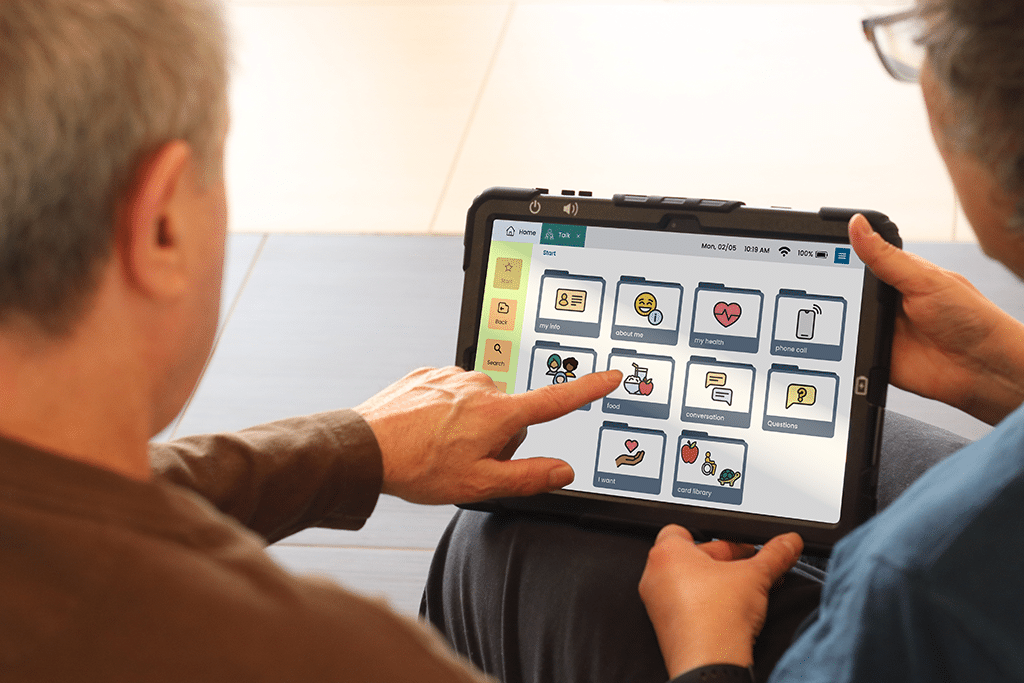
Our team handles setup and customization based on input from you, your client, and their care partner, so a device feels personal and ready for real-life conversation.
One-on-one device training
We provide personalized training sessions to help care partners feel confident using and supporting AAC at home.


When we say support, we mean it
Care partners are essential to every AAC journey. Their encouragement, consistency, and presence can make the difference between trying a device and truly using it. That’s why we meet care partners with empathy from the start. We speak their language, ease any uncertainty, and show them they’re not alone. They can do this, and we’ll be with them every step of the way.
Less busywork. More time for care.
We understand how much you’re already managing. That’s why our team handles key communication tasks to keep the trial moving smoothly:
- We prepare care partners by explaining what to expect during the trial.
- We follow up on documentation and keep the family informed.
- We remain available after the trial ends to answer questions and provide ongoing support.

With us, you’re supported too
We’re your partner in this. With Lingraphica on your side, you get:
- A partner who respects your time and clinical expertise
- A support system that engages families in the process
- Guides, demos, and resources to help you support AAC with confidence

Helpful Links for Care Partners
Support every step of the way



Frequently Asked Questions (What we help care partners understand)
Most care partners are completely new to AAC, and they’re likely to have questions. Here are some of the key questions we help answer, so you don’t have to do it all yourself:
We explain AAC in plain language and how it can support both immediate needs and long-term needs based on diagnosis.
We clarify that AAC does not prevent speech development. In fact, it often supports it. We reference relevant research and examples. (Fried-Oken et al., 2015; Dietz, Wallace, & Weissling, 2020)
We reassure care partners that no technical background is needed. Our team provides direct, personalized support during and after the trial. Plus, our devices are simple by design and often feel familiar for those who have used tablets or smartphones.
We explain how insurance coverage works and outline any potential out-of-pocket costs. We also offer help finding financial aid when needed.
We walk through our warranty and lifetime support policies, and explain how they can access ongoing help in English or Spanish.
We explain how the device protects data and maintains privacy, following industry best practices.